You went to take a shower and got a cold surprise. Or you walked into the garage and found a puddle spreading from the bottom of the tank. Either way, your water heater is telling you it's done.
Here in Colton, water heaters work harder than most folks realize. Our hard water leaves a layer of scale on the bottom of the tank that bakes on like crust in a pan, and that shortens the life of the unit year after year. A heater that should last twelve years often taps out closer to eight or nine around here.
When the repair bill starts creeping toward half the price of a new unit, replacing it is the smart move. We'll give you a straight answer on whether yours is worth saving, and if it isn't, we can often get a new one in the same day.
When Repair Stops Making Sense
Every tank water heater is on a clock. Inland Empire hard water speeds that clock up. Minerals settle at the bottom of the tank, the burner has to fire longer to heat through that crust, and eventually the steel weakens and the tank starts to weep. Once a tank is rusting from the inside out, there's no patch for it. A leak from the tank body itself is not a repair job, it's a replacement.
We start by figuring out what you actually have and what you actually need. A 40-gallon tank that was fine when the kids were small might be undersized now, or oversized and wasting money to keep water hot you never use. We look at how many people live there, how many bathrooms run at once, and whether gas or electric makes sense for your setup. Then we size the replacement to your house, not to whatever was sitting on the shelf.
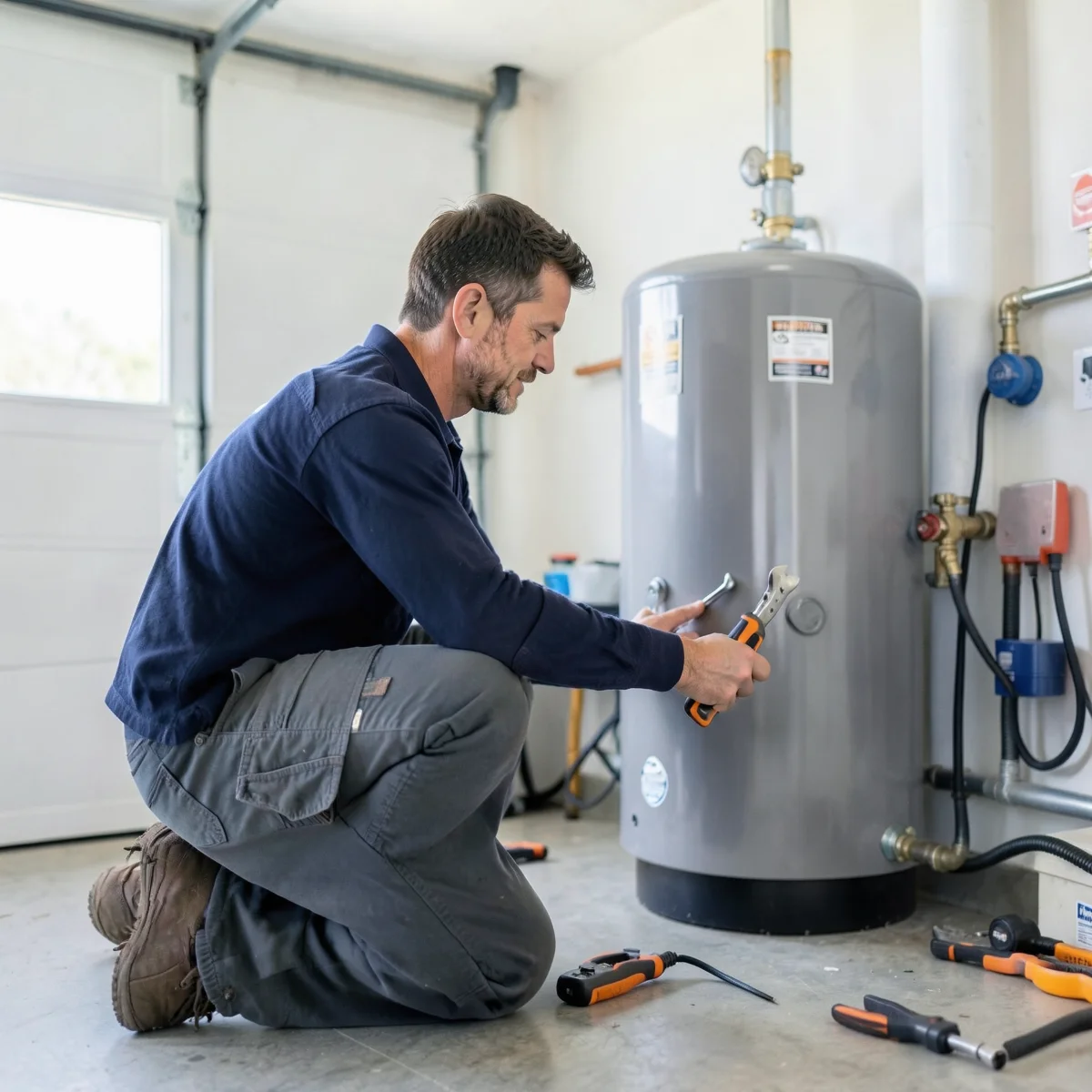
From there it's a clean swap. We drain and haul off the old unit, set the new one, reconnect the water, gas or electric, and venting, and bring everything up to current code. That means a proper drain pan, a new temperature and pressure relief valve, seismic straps that actually hold in a quake, and a flue that vents safely. You get hot water back and a unit that's installed right.
Signs It's Time to Replace, Not Repair
- Water pooling under or around the base of the tank
- Rust-colored or metallic-tasting hot water at the tap
- The tank is past 10 years old and starting to act up
- Popping or rumbling sounds when the burner runs (that's scale)
- Hot water runs out faster than it used to, even with no extra demand
- You've already paid for one repair and it's failing again