A burst pipe is one of the few home problems that gets worse by the second. One minute you've got a damp spot on the ceiling. Five minutes later you've got water running down the wall and pooling on the floor. The clock matters more than almost anything else here.
Most folks freeze when it happens. That's normal. But the difference between a small repair and a gutted kitchen usually comes down to what you do in those first few minutes, before you've even picked up the phone.
So here's the plan, the way I'd walk a neighbor through it over the fence. Do these things in order. We'll get to the burst pipe repair Colton CA part right after the bleeding stops.
Minute One: Shut Off the Water
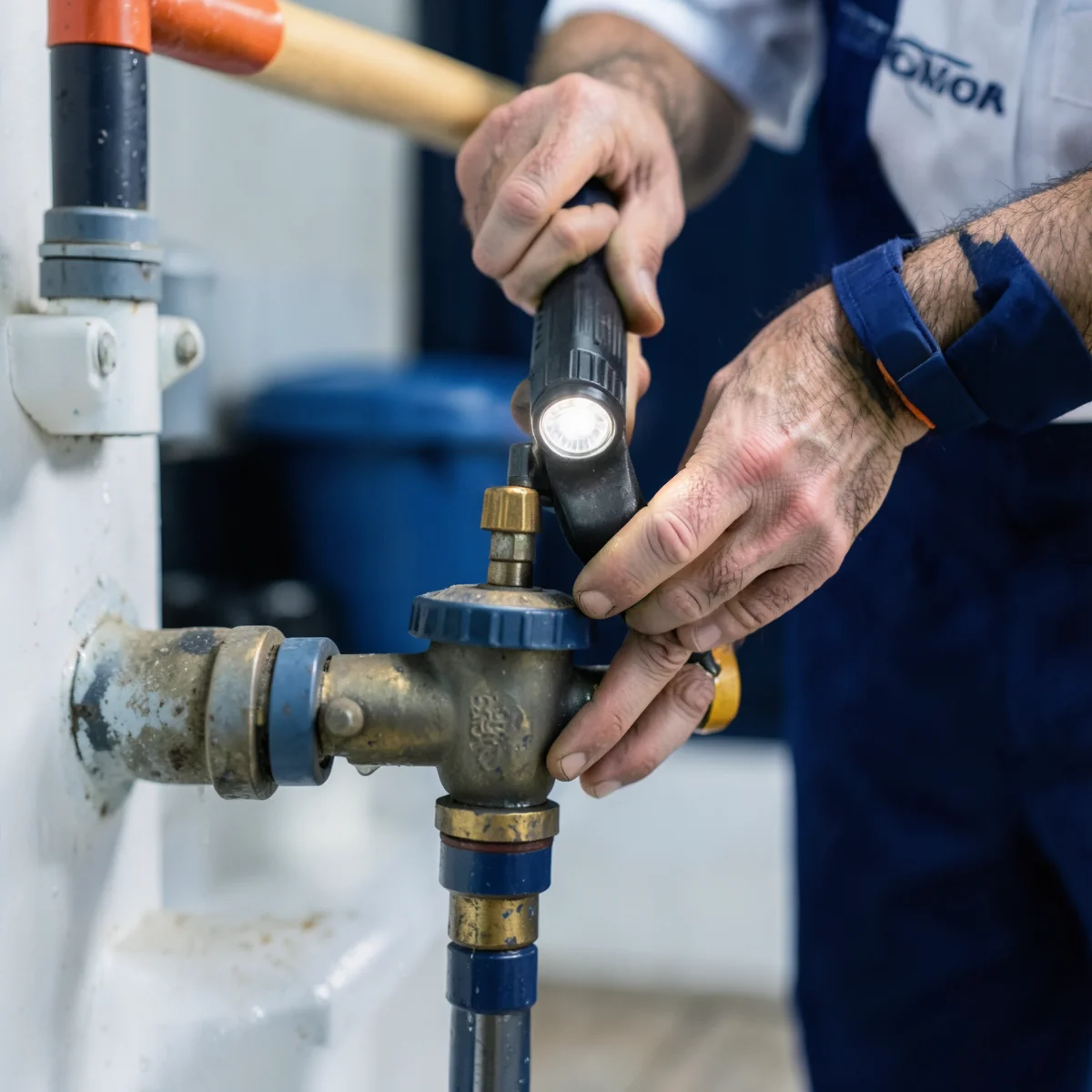
Everything starts here. Find your main shutoff valve and close it. That single move stops the flow at the source, and it does more good than any towel, bucket, or bowl you can throw at the problem.
In most Colton homes the main valve is in one of two places. Either it's near the front of the house where the water line comes in from the street, often in a box at the property line, or it's on the side of the house close to the hose bib. Older homes around Downtown Colton and South Colton sometimes hide it in a crawlspace or a closet, so it pays to know where yours is before you ever need it.
Turn it clockwise to close. If it's a round handle, righty-tighty. If it's a quarter-turn lever, swing it so it sits crosswise to the pipe. If the valve is stiff or won't budge, don't force it until it snaps. Move to the street meter instead and use the curb stop, though you may need a meter key for that.
- Main valve: usually front of the house or by the hose bib
- Turn clockwise to close, or swing a lever crosswise to the pipe
- Can't find it or it won't turn? Head to the meter at the curb
- Know where it is NOW, before a 2 a.m. emergency
Walk your house this week
Find your main shutoff and turn it once so you know it works. A valve that hasn't moved in fifteen years can seize up, and you do not want to discover that with water pouring through the ceiling.
Minute Two: Kill the Power and Drain the Lines
Water and electricity are a bad mix. If the leak is anywhere near outlets, light fixtures, or your electrical panel, shut off the power to that area at the breaker before you go wading in. If water is already pooling around the panel itself, stay back and call an electrician along with us.
Once the main is off, open the lowest faucets in the house and flush a toilet or two. This drains the water that's still sitting in the pipes so it doesn't keep dribbling out of the break. Open a few upstairs faucets too, since that helps the lines empty faster.
Then deal with what's already on the floor. Move furniture, lift rugs, get electronics up off the ground. Mop, towel, and shop-vac what you can. The faster you pull standing water, the less chance it soaks into the subfloor or wicks up your drywall and starts breeding mold in our warm Inland Empire climate.
Why Pipes Burst Around Here in the First Place
We don't get the hard freezes that crack pipes back east, not usually. A rare cold snap can still split an exposed pipe or an outdoor hose bib, so during a cold night it's worth disconnecting hoses and covering any bib that sits out in the open. But that's the exception, not the rule.
The bigger culprits in Colton are slower and sneakier. Our soil is the main one. The clay and adobe under a lot of these homes swells when it's wet and shrinks tight during drought, and that constant push-pull stresses the pipes running through your slab or under your raised foundation until a joint gives or a line cracks. We sit in a seismically active area too, so even a minor quake can shift a pipe just enough to loosen a fitting or open a hairline crack that finally lets go months later.
Then there's age and water chemistry. A ton of Colton houses went up between the 1940s and 1970s with galvanized steel pipe that's been rusting from the inside for decades. Add our hard water, which packs scale inside the lines and at every fitting, and you get pipes that are thin, brittle, and ready to fail. When one of those finally bursts, a patch is a band-aid. The real fix is usually repiping a section, or the whole house, in PEX or copper.
After a quake, take a look
Even a small shake can nudge fittings loose. If you notice damp spots, a drop in pressure, or rust-tinted water in the days after, get it inspected before a slow weep turns into a burst.
What Not to Do
Don't ignore a small leak and tell yourself you'll watch it. A pinhole today is a flood next month, especially with our soil shifting under the house. Catching it early is the cheapest plumbing you'll ever pay for.
Don't reach for drywall and paint to hide a stain without finding the source first. Sealing water inside a wall just grows mold where you can't see it, and now you've got two problems instead of one.
And don't crank a stuck shutoff valve with a pipe wrench and all your weight. Old galvanized valves snap, and a snapped valve turns a contained leak into an open fire hose. If it won't turn by hand with firm pressure, back off and go to the meter.
- Don't 'watch' a small leak, find the source
- Don't paint over water stains and call it done
- Don't force a seized valve until it breaks
- Don't run electronics or appliances in a flooded room
Then Call for Burst Pipe Repair
Once the water's off and you've pulled what you can off the floor, that's when you call. Tell us what burst, where it is, and whether you got the main shut off. That helps us show up ready instead of guessing in the driveway.
We're local Colton plumbers, so we're not coming from across the county. We run 24/7 emergency service with same-day availability, because a burst pipe at midnight doesn't wait for business hours. Our techs aren't on commission, so nobody's padding the job, and you get a straight, upfront price before any work starts.
When we get there we find the actual break, not just the wet spot, which often sits some distance from where you first saw water. Then we give you honest repair-versus-replace advice. Sometimes it's a clean fix on one section. Sometimes that old galvanized line is shot and you're better off repiping. Either way you'll hear it straight, with a flat-rate quote, not a sales pitch.
Frequently Asked Questions
Here's the whole thing in one breath: shut the main, kill the power if water's near it, drain the lines, get the standing water off the floor, then call. Do it in that order and you've already won the hard part.
When you're ready for a plumber, call (207) 419-2600. We're local, we answer 24/7, and we'll give you a straight quote and honest advice on whether to repair or replace. If a pipe just let go in your Colton home, get the water off and then get us on the phone, the sooner the better.
Plumbing Colton CA Team
Local plumbers serving Colton and the Inland Empire 24/7. We write these guides from the field — under slabs, in crawl spaces, and at cleanouts across the city. Questions? Call (207) 419-2600.