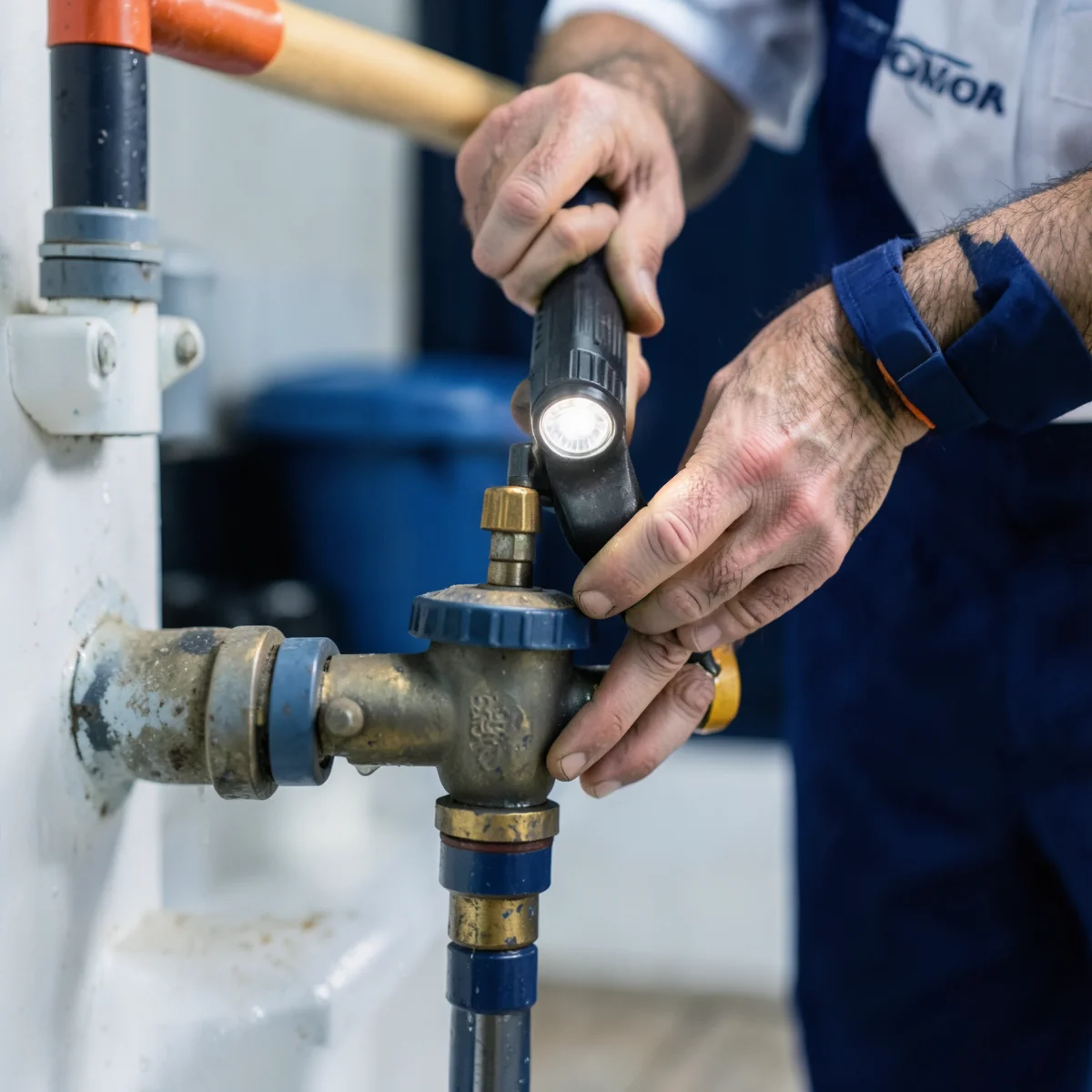
A pipe lets go at 2 a.m. Water is fanning across the kitchen floor and creeping toward the hall carpet. Right now, the single most useful thing you can do is not call anybody. It's walk to your shut-off valve and turn the water off. Thirty seconds there can be the difference between a mop-up and a five-figure repair bill.
Most folks here in Colton have no idea where that valve is until they're standing in an inch of water looking for it. That's a bad time to start the search. Clay soil shifts, old galvanized lines give out, a fitting loosens after a little shaker — and suddenly the clock is running.
So let's fix that today, while it's dry. I'll show you exactly where to find your shut-offs, how to turn them, and what to do in the minutes after. Keep this handy. When you do need emergency plumbing in Colton, CA, you'll already have bought yourself time.
Know your two shut-offs before you need them
You've actually got two places to kill the water, and they do different jobs. The first is the house-side valve. The second is the city meter valve out at the curb. Learn both. One of them will save your floors; the other is your backup when the first one won't budge.
The house-side valve is usually inside or just outside the home, on the pipe that brings water in. On a slab home, look in the garage on the wall closest to the street, near the water heater, or low on an exterior wall. On a raised-foundation house — and South Colton and North Colton have plenty of those — it's often in a little box near the front hose bib or under the house near where the line enters. Find it now and tag it with a bright zip tie so you can spot it in the dark.
The curb meter is the city's. In Colton it's typically a concrete or plastic box at the property line near the sidewalk, lid marked for water. Pop the lid and you'll see the meter and a valve on the street side. That valve is your whole-house off switch when nothing inside will turn.
- Garage wall facing the street — common on slab homes off Valley Boulevard and around Cooley Ranch.
- Near the water heater or low on an outside wall.
- A small in-ground box by the front hose bib on raised-foundation homes.
- The curb meter box at the property line — your last-resort whole-house shut-off.
How to actually turn it off
There are two valve types, and they close differently. A ball valve has a straight lever handle. Turn it a quarter-turn so the handle sits crosswise to the pipe — that's off. Quick and easy. A gate valve has a round wheel like an outdoor spigot. Turn it clockwise, righty-tighty, and keep going until it stops. It may take several full turns.
Here's the honest warning about gate valves: a lot of Colton homes built in the 1940s through the 1970s still have them, and the old ones seize from hard-water scale. The Inland Empire's hard water leaves mineral buildup that locks the stem. Force a corroded gate valve and the stem can snap off in your hand, or it'll dribble and never fully seal. Turn it firmly but don't go gorilla on it. If it won't move, go straight to the curb meter instead.
For the curb valve you'll want a meter key — a cheap L-shaped tool from any hardware store. A long screwdriver and a wrench can work in a pinch. Slot it onto the valve and turn a quarter-turn until it's crosswise. Buy the key today and drop it in the box or by the door. Digging through a junk drawer with water rising is not a plan.
Test it once a year — gently
A valve that never moves is a valve that seizes. Once a year, close your house-side valve and reopen it just to keep it working. If it's stiff, leaking, or stuck, that's a five-minute fix on a calm day instead of a disaster at midnight. Call (207) 419-2600 and we'll swap a tired gate valve for a quarter-turn ball valve.
The first five minutes after the water's off
Once the main is closed, open the lowest faucet in the house — usually an outside hose bib or a downstairs tub — to drain the pressure out of the lines. Then open a faucet upstairs or at the highest point. That lets air in and pulls the standing water down and out of the pipe, so the broken spot stops weeping while you wait.
If the leak is anywhere near outlets, the panel, or a light fixture, kill the power to that area at the breaker before you wade in. Water and electricity in the same room is how a plumbing problem becomes a hospital trip. When in doubt, stay out and shut the main breaker.
Now deal with the water that already got out. Pull rugs up, get furniture legs onto blocks or foil, and move boxes off the floor. Snap a few photos for your insurance before you start hauling things around. Our slab homes can wick water under flooring fast, so the quicker you lift and dry, the less you'll be tearing out later.
Why Colton homes spring these leaks in the first place
This isn't bad luck. It's the ground and the plumbing we've got. Colton sits on clay, sandy loam, and adobe that swells when it's wet and shrinks in drought. That constant push-and-pull stresses the pipes running under slabs and raised foundations, and over the years it cracks lines and pulls joints apart.
Add the housing stock. A huge share of homes from Reche Canyon to Downtown Colton were plumbed with galvanized steel or polybutylene. Galvanized rusts from the inside until you get low pressure, rust-tinted water, and pinhole leaks that show up overnight. Polybutylene gets brittle and fails at the fittings. The real fix isn't another patch — it's repiping to PEX or copper. And because we're seismically active, even a small quake can loosen a fitting that was already living on borrowed time.
None of that means you panic. It means you respect it. Know where your shut-offs are, keep them working, and when the same spot keeps leaking, stop chasing it with tape and get a straight answer on repair versus repipe.
Frequently Asked Questions
Take ten minutes this weekend. Walk out, find both shut-offs, tag the inside one, and buy a meter key. Give the house-side valve a test turn so you know it works. That's the whole drill, and it's the cheapest insurance against water damage you'll ever buy in this town.
When the leak is already running and you need a hand, that's what we're here for. We're local Colton plumbers offering 24/7 emergency service with upfront, flat-rate pricing and honest repair-or-replace advice — no commission, no surprises. Call (207) 419-2600 and we'll get someone moving. Save the number now so it's already in your phone when the water's on the floor.
Plumbing Colton CA Team
Local plumbers serving Colton and the Inland Empire 24/7. We write these guides from the field — under slabs, in crawl spaces, and at cleanouts across the city. Questions? Call (207) 419-2600.