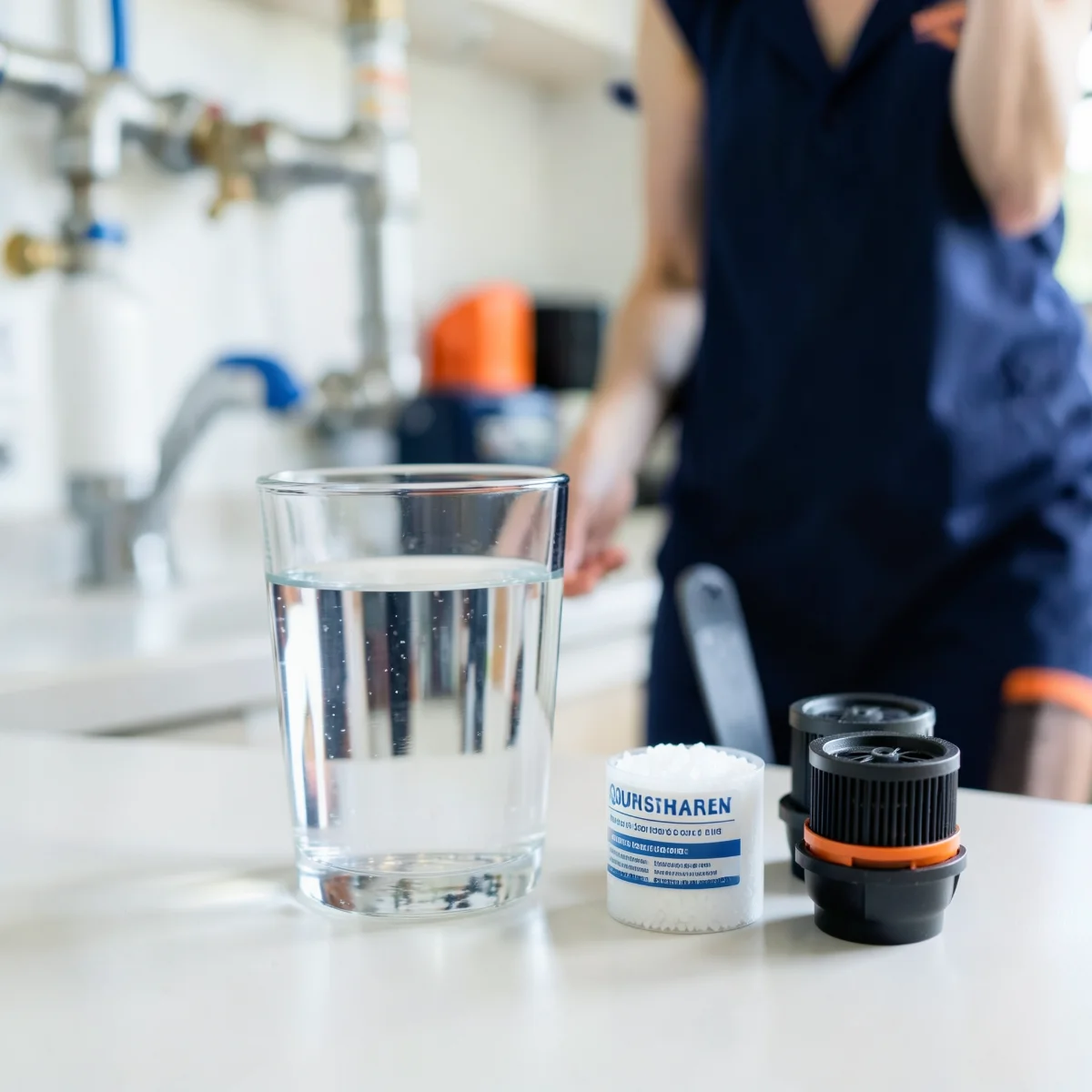
Run your thumb over the faucet in your kitchen. Feel that chalky, crusty white stuff around the spout? That's scale. It's hard water leaving minerals behind, and you can scrub it off the outside all day long.
Here's the part nobody scrubs. The same buildup is happening on the inside — coating the walls of your pipes, packing the bottom of your water heater, and choking the little screens in your faucets and shower valves. You don't see that part until the pressure drops or the water heater quits early.
Hard water is just a fact of life across the Inland Empire, and Colton is right in the thick of it. It won't flood your house overnight. But it costs you slowly and steadily, one degraded fixture and one shortened appliance life at a time. Let me walk you through what it actually does down there, so you know what you're paying for and what you can do about it.
What hard water actually is, and why Colton gets it
Hard water just means there's a lot of dissolved mineral in it — mostly calcium and magnesium. The water itself is perfectly safe to drink. The trouble is what those minerals do when the water sits, heats up, or evaporates. They drop out and stick to whatever they were touching. That dried-on residue is scale, and it builds in layers the same way limescale builds in a kettle.
Across the Inland Empire, from Rialto and Bloomington over to Loma Linda and Redlands, the water comes up hard. Colton is no different. Whether you're off Valley Boulevard, up in Reche Canyon, or over in Cooley Ranch, the water coming into your house carries a real mineral load, and every fixture in the place feels it over time.
None of this is a defect in your plumbing or your water. It's just the water we've got. But hard water plumbing Colton CA homes deal with is a slow grind on the whole system, and the houses that ignore it pay for it in worn-out fixtures and water heaters that die years before they should.
What scale does to your pipes and fixtures
Inside the pipe, scale builds up like plaque in an artery. A little at a time, year after year, the inside diameter of the line gets narrower. Less room for water means less flow, and you start noticing weak pressure at the shower or a kitchen faucet that used to blast and now just trickles.
It hits the small parts hardest because they have the least room to spare. The aerator screen on a faucet, the tiny ports in a showerhead, the cartridge inside a single-handle mixer — all of them clog with mineral grit. That's why a showerhead goes from a wide spray to a few crooked streams, and why a faucet handle starts feeling stiff or sticky to turn.
Toilets get it too. Scale builds up under the rim where the water comes in and inside the fill valve, so the bowl doesn't rinse as clean and the tank takes longer to refill. None of these are emergencies on their own. But add them all up and your whole house is running at half speed and looking grimy no matter how hard you clean.
- Showerheads that spray crooked or weak — mineral grit clogging the holes.
- Faucet aerators that drip or barely flow until you unscrew and soak them.
- Stiff or sticky faucet handles and valves where scale has crept into the cartridge.
- Spotty glasses and a film on shower doors that comes right back after cleaning.
- Whole-house pressure that's slowly dropped over the years for no obvious reason.
Your water heater takes the worst of it
If hard water has one favorite victim in your house, it's the water heater. Heat speeds up the whole process, so minerals drop out fastest right where the water gets hottest — the bottom of the tank, sitting right on top of the burner or the heating element.
Over a few years that sediment piles up into a thick crust at the base of the tank. On a gas heater, that layer sits between the flame and the water, so the burner has to run longer and hotter to push heat through it. You pay for that on the gas bill, and the extra heat stress shortens the life of the tank. That rumbling or popping sound an old heater makes is water trying to boil its way up through the sediment.
A tank packed with scale also holds less actual hot water, because the sediment takes up room that used to be water. So you run out in the shower sooner, the heater works harder to keep up, and the whole unit wears out years ahead of schedule. Flushing the tank once a year clears a lot of that out and is the single best thing you can do to stretch its life.
Listen to your water heater
If your tank rumbles, pops, or knocks like there's gravel rolling around inside, that's sediment from hard water boiling underneath the crust. It's a sign the heater is working harder than it should and losing capacity. A yearly flush helps, but a tank that's already crusted and noisy is on borrowed time — better to plan the replacement than get surprised by a cold shower or a leak across the garage floor.
The real cost, and what it pairs badly with in older Colton homes
Hard water rarely sends you one big bill. It nickel-and-dimes you. A showerhead here, a faucet cartridge there, a water heater that quits at eight years instead of twelve, a gas bill that's a little higher every month because the burner fights through sediment. Spread over a decade, that adds up to real money.
It gets worse when scale meets old pipe. A lot of Colton's housing went in between the 1940s and 1970s, and plenty of it still has galvanized steel lines, especially around South Colton and the older streets off Mount Vernon Avenue. Galvanized rusts and narrows on its own from the inside, and hard water scale on top of that closes the pipe down even faster. That's the one-two punch behind rust-tinted water and pressure that keeps fading no matter what you swap out at the fixture.
When the pipe itself is the bottleneck, no aerator cleaning fixes it. The honest answer at that point is repiping to PEX or copper, which you do once and then stop fighting. Hard water doesn't cause the old-pipe problem, but it absolutely speeds it along, which is why so many older homes here hit the wall sooner than the same house would somewhere with softer water.
- Higher gas or electric bills from a water heater fighting through sediment.
- Fixtures and cartridges replaced years before they should wear out.
- A water heater that fails early — often the priciest single hit.
- Faster decline in old galvanized pipe, pushing repiping up the calendar.
What you can actually do about it
You've got a few levels here, and they range from a weekend chore to a real fix. At the simplest end, you maintain. Unscrew faucet aerators and showerheads and soak them in vinegar to dissolve the scale. Flush your water heater once a year. That alone keeps a lot of the slow damage at bay and costs you almost nothing but time.
The real fix for the whole house is a water softener. It pulls the calcium and magnesium out before the water ever reaches your pipes, so scale stops building in the first place. New fixtures stay clean, the water heater runs cleaner and lasts longer, and soap actually lathers instead of leaving that film. For a lot of Colton homes it pays for itself over the years in fixtures and appliances that quit dying early.
And when scale has teamed up with old galvanized pipe and the pressure just won't come back, that's when we talk repiping. The right move depends on your house and what's behind the walls, which is exactly the kind of repair-versus-replace call worth getting a straight answer on before you spend a dime.
Frequently Asked Questions
Hard water is the quiet tax on a Colton home. It won't kick your door in, but it's scaling up your pipes, packing your water heater, and wearing out your fixtures the whole time you're not looking. The good news is hard water plumbing Colton CA homeowners face is manageable once you know what you're dealing with — a yearly flush and some maintenance for the small stuff, a softener to stop it at the source, and an honest repipe conversation only if old pipe has made it worse.
If your pressure keeps fading, your water heater rumbles, or that white crust just won't quit, let's figure out what's really going on before you throw money at the wrong fix. We're local Colton plumbers — free estimates, upfront pricing, and a straight answer on whether it's a simple repair or time to replace. Call (207) 419-2600 and let's get ahead of it.
Plumbing Colton CA Team
Local plumbers serving Colton and the Inland Empire 24/7. We write these guides from the field — under slabs, in crawl spaces, and at cleanouts across the city. Questions? Call (207) 419-2600.