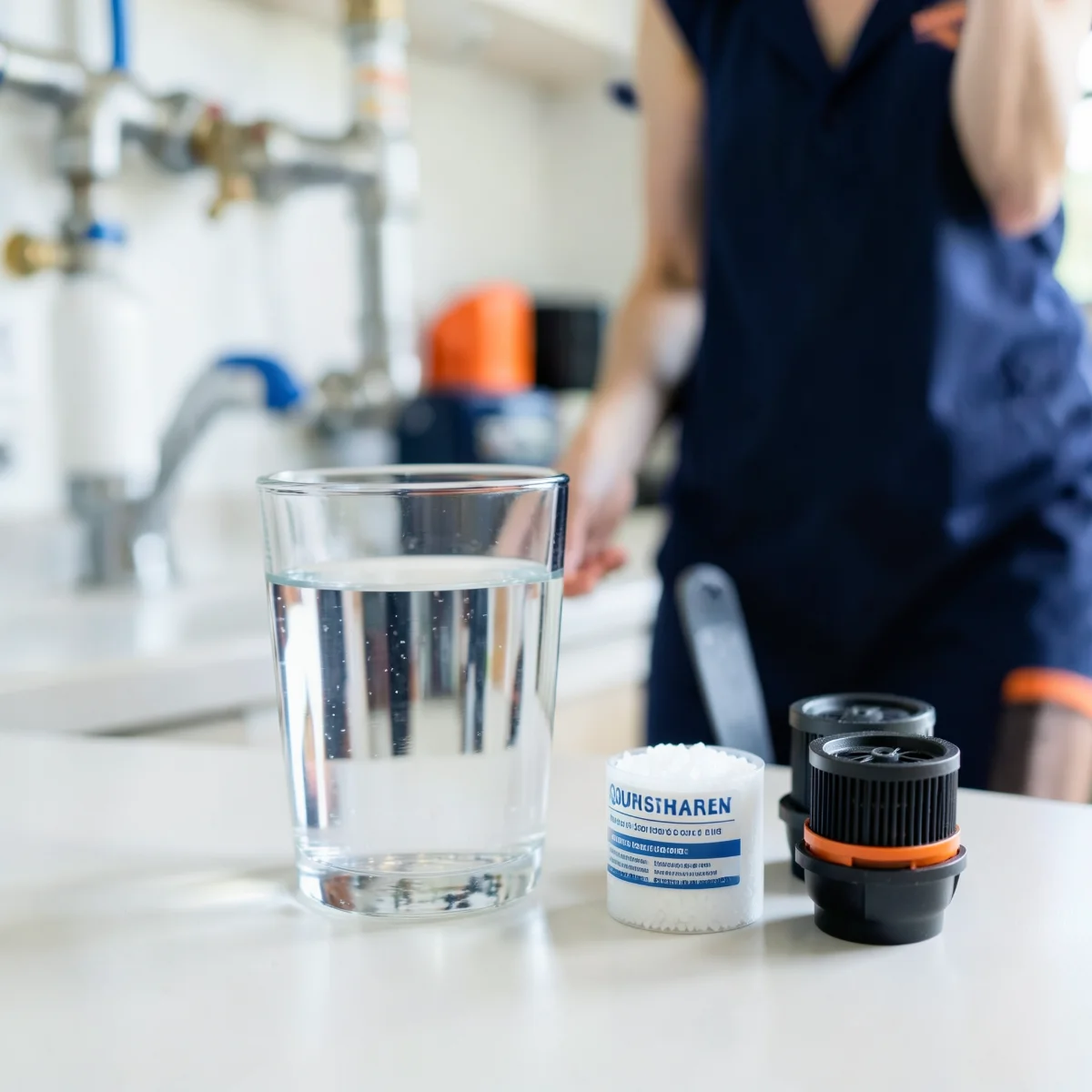
Run your hand along a glass that came out of the dishwasher. Feel that chalky film? Notice the white crust building up around the faucet aerator, or the soap that never quite rinses off in the shower? That's Colton water talking.
We sit in the middle of the Inland Empire, and the water here is hard. Really hard. It picks up calcium and magnesium on its way to your tap, and that mineral load shows up everywhere — on your fixtures, inside your pipes, and on the bottom of your water heater. So the question a lot of folks ask makes sense: do you need a whole-house filter, a softener, or both?
Here's the straight answer up front. Most Colton homes don't have a contamination problem that a filter solves. They have a hardness problem that a softener solves. But the two get sold together all the time, and plenty of homeowners end up paying for equipment they don't need. Let's sort out what actually fixes Colton's water and whether whole-house filtration is worth your money.
Filter vs. softener: they don't do the same job
People use 'filter' and 'softener' like they're the same thing. They're not, and mixing them up is how you buy the wrong box.
A whole-house filter removes stuff from the water — sediment, chlorine taste and smell, sometimes funky odors. A water softener doesn't filter anything out. It swaps the calcium and magnesium that make water 'hard' for sodium, so the minerals stop building scale. If your real problem is crusty fixtures and dingy laundry, a filter won't touch it. You need softening.
So before you spend a dollar, figure out what's actually bugging you. Spots and scale point to hardness. Taste, smell, or grit point to filtration. A lot of Colton homes notice the hardness first because it's impossible to ignore once you start looking.
- Whole-house filter: pulls sediment, chlorine taste, and odors out of the water.
- Water softener: trades hardness minerals for sodium so scale stops forming.
- Spotty glasses and crusty faucets = hardness, not contamination.
- Bad taste or smell, or grit in the aerators = filtration.
Why Colton water is hard on your whole house
Hard water isn't just a cosmetic annoyance. It's quietly expensive. Every time hard water heats up, those minerals drop out and cake onto whatever they touch. The worst spot is the bottom of your water heater, where scale builds into a crust that forces the unit to work harder and die younger. I've pulled tanks out of homes off San Bernardino Avenue that were barely past the warranty and already half-full of mineral sludge.
It hits the rest of the house too. Scale narrows the inside of your pipes over the years, cutting flow. It shortens the life of dishwashers and washing machines. It clogs aerators and showerheads. And it makes you use more soap and detergent because nothing lathers right in hard water.
Now add Colton's older housing into the mix. A lot of homes around Downtown Colton, South Colton, and Cooley Ranch were built between the 1940s and 1970s, and some still have galvanized steel pipe. Galvanized rusts and scales from the inside out on its own — hard water just speeds that up. If your water comes out rust-tinted or your pressure has been dropping for years, the pipe itself may be the bigger issue, and no filter or softener fixes corroded steel.
Quick test you can do today
Fill a clear bottle halfway with tap water, add a few drops of dish soap, cap it, and shake hard. Soft water makes a tall, foamy head that lasts. Hard water makes thin, quick-collapsing bubbles and a cloudy look. It's not lab-grade, but it tells you a lot in ten seconds.
So is whole-house filtration worth it in Colton?
Here's where I save some of you money. If your only complaint is hardness — spots, scale, soap that won't rinse — a whole-house filter by itself is the wrong tool. You'd be filtering water that's already clean of contaminants and doing nothing about the minerals causing your headache. A softener is the fix.
Whole-house filtration earns its keep when you've got a taste or smell you want gone, you're on older galvanized pipe shedding sediment into your fixtures, or you just want cleaner water at every tap instead of one filter pitcher in the fridge. Plenty of Colton families do want that, and that's a fair reason to install one. Just buy it for the right reason, not because it came bundled.
For most homes around here, the smart setup is a softener for the scale and, if you care about taste and chlorine, a filter ahead of it. That combo tackles both problems and protects your water heater and appliances at the same time. When you're weighing water filtration systems Colton CA installers offer, ask exactly what each piece does for your specific water — not what it does in a brochure.
- Hardness only? Get a softener. A filter alone won't help.
- Taste, chlorine, or sediment from old pipe? A whole-house filter makes sense.
- Want it all? Filter plus softener covers both, but only buy what fits your water.
- Skip any pitch that bundles equipment without explaining what each part does.
What a softener and filter won't fix
This is the part the equipment salesman skips. Water treatment cleans up the water. It does nothing for the pipes carrying it. If you live in one of Colton's older neighborhoods and you've got galvanized steel or polybutylene, softer water won't bring back lost pressure or stop pinhole leaks. Those pipes are at the end of their road, and the real fix is repiping to PEX or copper.
Same goes for what's happening outside the house. Our clay and adobe soil expands when it's wet and shrinks in drought, and that constant movement stresses lines and cracks joints. We're also in seismically active country, where even a small shake can shift a pipe or loosen a fitting. And older streets around North Colton and Reche Canyon often run on clay sewer lines that tree roots love to invade. None of that is a water-quality problem — it's a plumbing problem, and it needs a different fix like trenchless lining for the sewer or a repipe for the supply.
I bring this up because I've watched homeowners drop real money on a softener while their actual trouble was a corroded main or a root-choked sewer. Treat the water if the water needs treating. But get someone to look at the whole picture first so you're not solving the wrong thing.
Frequently Asked Questions
Bottom line: Colton's water is hard, and for most homes a softener is what actually fixes the scale and spots. Whole-house filtration is worth it when you want better taste or you're dealing with sediment from older pipe — but buy it because it solves your problem, not because it came bundled with something else. And if your pressure's dropping or your water runs rusty, look at the pipes before the water, because no filter fixes corroded steel.
Not sure which way to go? We're local Colton plumbers, and we'll give you honest repair-vs-replace advice instead of a sales pitch. We can test your water, check your lines, and tell you straight what's worth doing. Call (207) 419-2600 to schedule a free estimate and we'll help you fix the right thing the first time.
Plumbing Colton CA Team
Local plumbers serving Colton and the Inland Empire 24/7. We write these guides from the field — under slabs, in crawl spaces, and at cleanouts across the city. Questions? Call (207) 419-2600.