You turn off the kitchen faucet and the wall thumps. The shower bangs when the washer kicks on. Maybe a toilet fill valve started screaming for no reason, or a faucet supply line let go under the sink while you were at work. That noise and those leaks usually trace back to one part most folks in Colton never think about: the pressure regulator, sitting right where the city main meets your house.
Here in Colton, City water pressure can run hard, and your home is built to handle a set range, not whatever the main feels like sending that day. The pressure regulator, also called a PRV, is what keeps it tamed. When it wears out, pressure either climbs too high and beats up every fixture you own, or it sags and your showers go weak.
We're local Colton plumbers, and pressure regulators are bread-and-butter work for us. We'll test what's actually coming into your house, tell you straight whether the PRV needs adjusting or replacing, and give you the quote before we touch a wrench.
Why a Bad Pressure Regulator Wrecks the Whole House
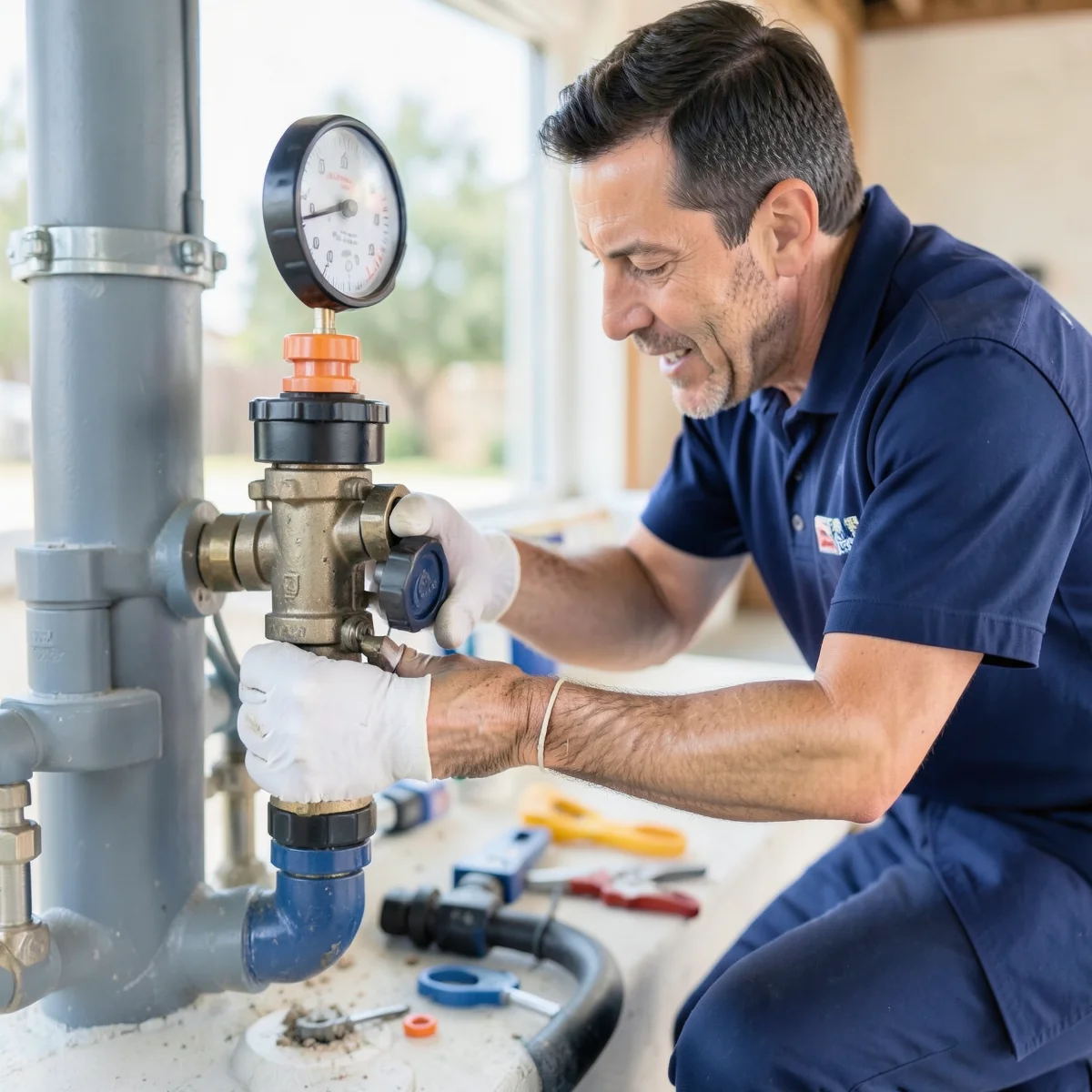
A pressure regulator is a brass valve set just past your main shutoff, often in a box near the front of the house or where the line enters from the street. Its one job is to take the city's incoming pressure and knock it down to a safe level, usually somewhere around 50 to 60 psi, before it spreads through your pipes. When it fails, it fails in one of two directions. Stuck open, it lets full main pressure blow through and you get water hammer, banging pipes, blown supply lines, and faucets that splash like a fire hose. Stuck closed or worn down, it chokes the flow and every tap in the house dribbles.
High pressure is the quiet killer. Run 80, 90, even 100 psi through a house day and night, and you're shortening the life of your water heater, your dishwasher, your washing machine, and every braided supply hose under every sink. Those little hoses are usually the first to burst, and they always seem to go when nobody's home. Out here the hard water doesn't help either, since scale builds up inside the regulator itself and seizes the diaphragm so it can't do its job.
Here's how we fix it. We put a gauge on a hose bib and read your real static pressure first, because guessing is how people throw money at the wrong part. If the regulator just drifted out of adjustment, sometimes a careful turn brings it back in range. If the diaphragm is shot or it's caked with mineral scale, we replace the whole valve with a new one sized for your line and dial it to the right pressure on the spot. Then we re-test so you can see the number before we pack up.
Signs Your PRV Is Going Bad
- Pipes bang or hammer when you shut off a faucet or the washer or toilet stops filling
- Faucets blast and splash, or the toilet tank fills way too fast and loud
- Supply hoses, fill valves, or the water heater's relief valve keep failing or dripping
- Water pressure swings high in the morning and weak later, or differs room to room
- Whole-house pressure has dropped low and slow even though the City of Colton shows no main issue
- You can see water seeping or pooling around the regulator box near the front of the house