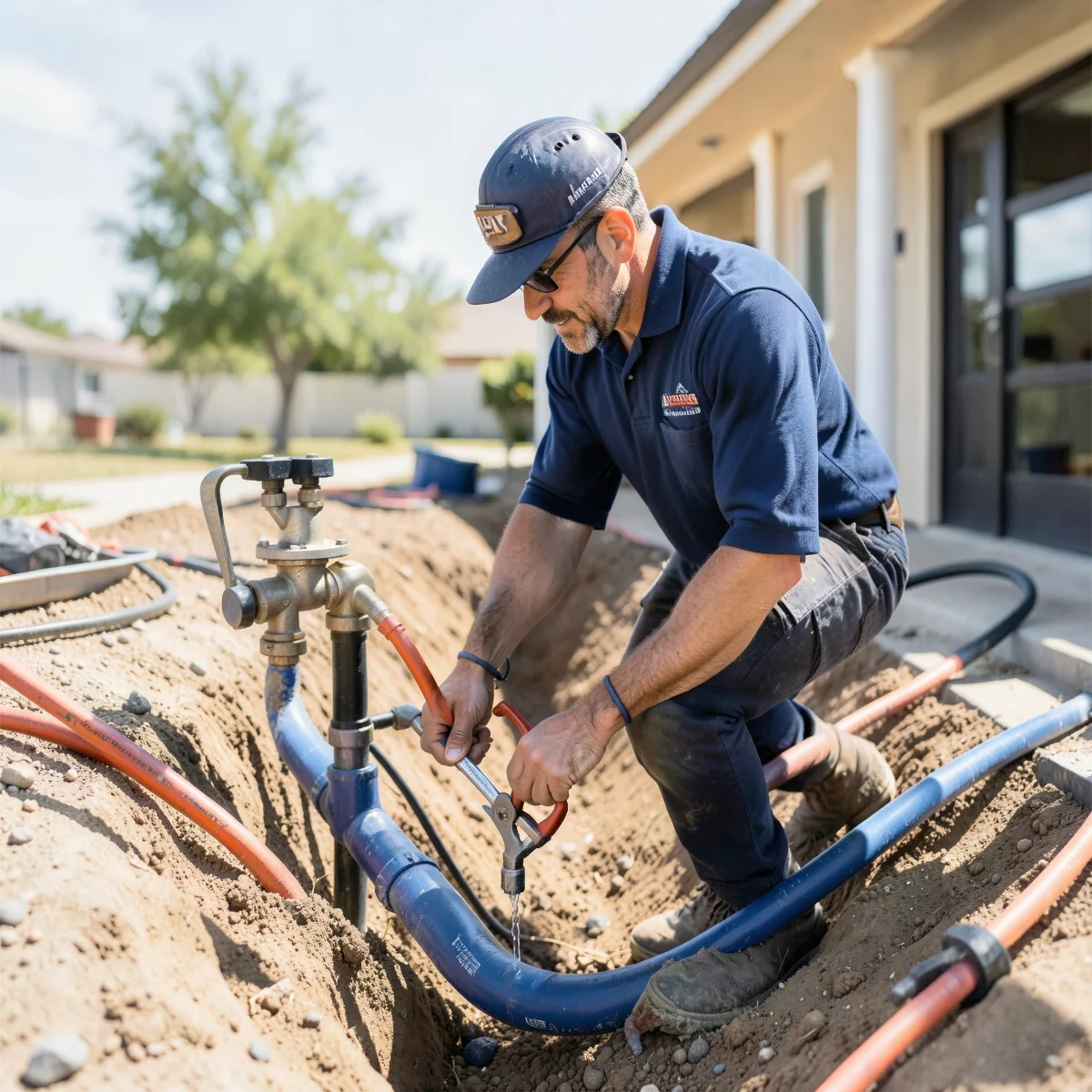
Your water line is the pipe that carries fresh water from the city meter at the street into your Colton home. You never think about it until it starts going wrong. Then suddenly the pressure's down across the whole house, the water's coming out tinted, or there's a soft wet patch in the yard that won't dry out even in June.
When that buried line is old or leaking, patching one spot rarely holds. The next pinhole shows up a few feet down the same corroded run. At that point the real fix is replacing the line, and you've got more options than you'd think.
We're local Colton plumbers, and we replace water service lines both ways. Trenchless, where we pull new pipe through without trenching your whole front yard, or open-cut when that's the smarter, cheaper call. We'll tell you straight which one your line actually needs.
Why Your Water Line Gives Out
A lot of Colton's homes from the 1940s through the 1970s were plumbed with galvanized steel, and some of the later ones got polybutylene. Both have a shelf life. Galvanized rusts from the inside out until the bore chokes down and the water comes through tinted with that rust color. Poly gets brittle and splits at the fittings. Either way you end up with weak pressure, leaks, or both, and a patch on a line that old just resets the clock until the next failure.
Then there's the ground your line is buried in. Colton sits on clay, sandy loam, and adobe that swells when it's wet and pulls back hard when it dries out. That constant push-and-pull strains a buried supply line and works at the joints. Add hard water scaling up the inside of the pipe, plus a seismic region where even a small quake can shift a line underground, and an old service line doesn't stand much of a chance long-term.
When the pressure's dropped across the whole house, the water's discolored, or there's a leak you can't keep ahead of, replacement beats chasing it. We run new pipe from the meter to the house, usually PEX or copper, that won't rust, won't scale up the same way, and flexes with Colton's shifting soil instead of cracking like old galvanized. We show you what we found first, give you an upfront flat-rate quote, and let you decide. No commission padding the bill.
Signs Your Water Line Needs Replacing
- Pressure dropped across the whole house at once, not just one faucet
- Rust-colored or cloudy water, especially first thing in the morning
- A soggy patch or running water in the yard between the meter and the house
- Your water bill jumped and the meter keeps ticking with everything off
- The home dates to the 1940s through 1970s and still has galvanized or poly pipe
- You've patched the supply line before and it leaked again somewhere nearby